Landmark Exchange Public Issue Master Intelligence
🏛️ National Stock Exchange (NSE) IPO: Comprehensive RHP Details, Financial Forensics, Timeline & Valuation Blueprint
Exhaustive Analysis of ₹22,561.57 Cr Issue Size, ₹1,700-₹1,785 Price Band, FY26 PAT ₹10,302.06 Cr, Peer Multiples & Allotment Schedule
📅 Opens: Sep 17, 2026
 Total Issue Size
National Stock Exchange (NSE) IPO: The Definitive Research Report on India’s Capital Market Titan
The official announcement of the Initial Public Offering (IPO) by the National Stock Exchange of India Limited (NSE) marks a monumental turning point in the financial history of the Indian subcontinent. Opening for subscription from September 17, 2026, to September 21, 2026, with an aggregate issue size of ₹22,561.57 Crore, this public offering is structured entirely as an Offer for Sale (OFS). As the undisputed operational nucleus of India’s secondary equity markets, derivative contracts, and capital formation pipelines, NSE’s upcoming public issue ranks among the largest capitalization events ever witnessed on domestic bourses.
1. Key IPO Parameters & Timetable Schedule
The foundational transaction parameters and official timeline outlined in the prospectus establish clear boundaries for investors: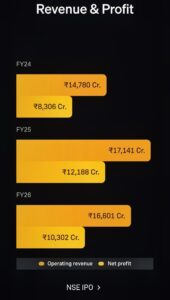
| IPO Parameter | Official Details Revealed |
|---|---|
| Opening & Closing Dates | September 17, 2026 to September 21, 2026 |
| Price Band | ₹1,700.00 to ₹1,785.00 per share |
| Face Value | ₹1 per Equity Share |
| Minimum Retail Investment | 1 Lot = 8 Shares (₹14,280 at upper price band) |
| Total Issue Size | ₹22,561.57 Crore (100% Offer for Sale) |
| Basis of Allotment | September 22, 2026 (Tentative) |
| Listing Date | September 24, 2026 on BSE Limited |
2. Reservation Quotas for Investor Categories
| Investor Category | Allocation Quota |
|---|---|
| Qualified Institutional Buyers (QIB) | Not more than 50% of the Net Offer |
| Retail Individual Investors (Retail / RII) | Not less than 35% of the Net Offer |
| Non-Institutional Investors (NII / HNI) | Not less than 15% of the Net Issue |
3. Three-Year Financial Snapshot & Earnings Forensics (Figures in ₹ Crores)
| Period Ended | Total Income | Profit After Tax (PAT) | EBITDA | Net Worth |
|---|---|---|---|---|
| 31 Mar 2024 | 16,352.06 | 8,305.74 | 11,623.83 | 23,833.10 |
| 31 Mar 2025 | 19,176.83 | 12,187.69 | 16,021.36 | 30,165.05 |
| 31 Mar 2026 | 18,713.37 | 10,302.06 | 14,519.09 | 31,868.72 |
| 30 Jun 2026 | 5,252.17 | 3,120.08 | 4,332.04 | 34,983.74 |
4. Peer Group Valuation Benchmark
| Exchange Name | EPS (Basic) | P/E Ratio | RoNW (%) | NAV (₹) |
|---|---|---|---|---|
| BSE Limited | 60.61 | 54.28 | 45.00 | 163.60 |
| National Stock Exchange (NSE) | 41.62 | 42.89 | 33.21 | 129.75 |
5. Corporate Headquarters & Official Registrar Contacts
Company Registered Office
National Stock Exchange of India Limited
Exchange Plaza, C-1, Block G, Bandra Kurla Complex, Bandra (East), Mumbai 400 051
Website: https://www.nseindia.com ↗
Official IPO Registrar
MUFG Intime India Private Limited
Phone: 91 810 811 4949
Website: MUFG Registrar Portal ↗
Strategic Market Evaluation: The Significance of Exchange Listings in India
The prospective public offering of the National Stock Exchange (NSE) represents a watershed moment for Indian equity markets. As the primary platform driving secondary market liquidity, derivatives trading, and capital formation, NSE’s transition from a mutually owned exchange structure to a publicly traded corporate entity unlocks profound intrinsic value. Institutional investors and retail stakeholders evaluate exchanges based on operating leverage, network effects, and high barriers to entry.
1. Operational Scale and Fee-Based Revenue Resilience
Unlike traditional manufacturing or cyclical enterprises, financial market infrastructure providers (FMIPs) benefit from robust transaction-driven revenue streams. Every trade execution, clearing operation, listing fee, and data connectivity service generates high-margin cash flows. NSE’s historical financial performance—highlighted by a PAT margin exceeding 50%—demonstrates exceptional cost discipline and scalable technological architecture capable of handling billions of daily quote requests without linear cost increments.
2. Regulatory Frameworks and Ownership Governance
Because exchanges perform quasi-regulatory functions in monitoring market integrity, surveillance, and clearing guarantees, their public listing is subject to stringent oversight by SEBI. Regulations dictate strict limits on individual voting rights, promoter shareholding lock-ins, and institutional conflict-of-interest disclosures. The decision of major institutional backers like LIC to retain their holdings underscores long-term confidence in India’s structural macroeconomic growth and secular rise in financial asset penetration.
3. Long-Term Outlook for Investors and Market Participants
As India marches toward becoming a developed economy, the deepening of capital markets will continue to channel household savings into equities through mutual funds and direct trading accounts. As the backbone of this ecosystem, NSE is uniquely positioned to compound its earnings over decades. Retail investors evaluating this issue must weigh the sheer scale of the company against prevailing market multiples upon price band announcement.
SEBI Compliance Note: ipoind.com is an independent financial analytics and primary market research portal provided solely for educational and informational purposes. We are NOT a SEBI-registered Investment Advisor or Research Analyst. Financial market investments, equity securities, and Initial Public Offerings (IPOs) carry inherent market risks.
Grey Market Premium (GMP) Notice: Figures regarding Grey Market Premium (GMP), Kostak rates, and subject-to-sauda deals reflect unofficial, unregulated over-the-counter market sentiment. These figures do not guarantee exchange listing prices or actual trading outcomes. Always evaluate official Draft Red Herring Prospectus (DRHP / RHP) documents filed with BSE/NSE and consult a certified financial advisor prior to executing financial bidding decisions.